Why I Love Being a Polymath

People sometimes ask me, “How do you do so many things?”

My honest answer: I don’t know how NOT to.

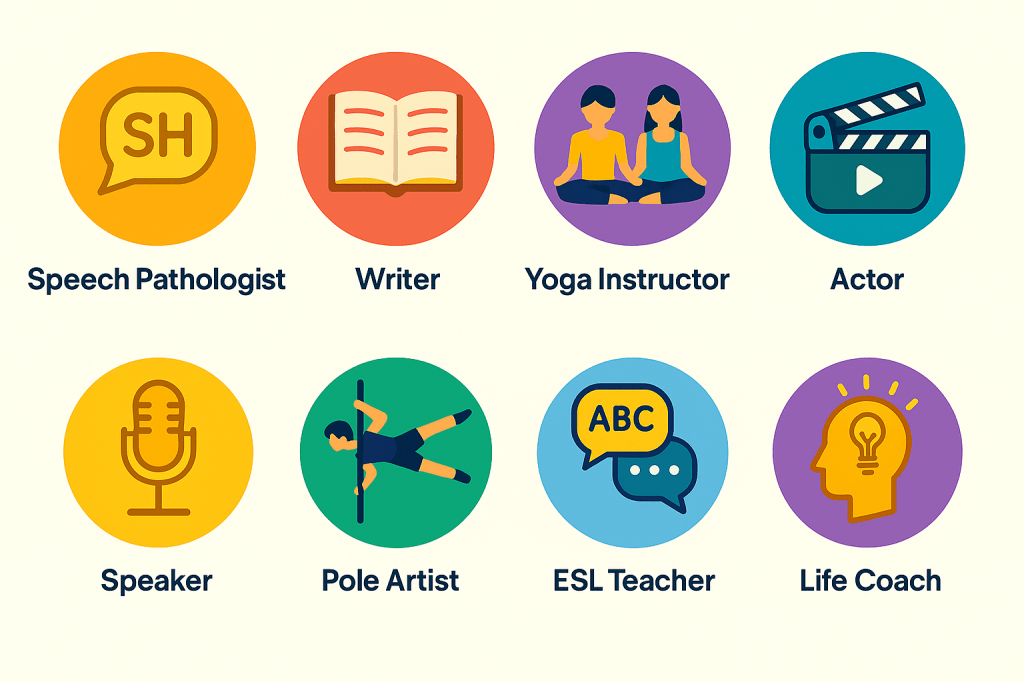
I’ve never been someone who fits neatly into one box. I’m a speech pathologist, a writer, a life coach, an actor, a yoga teacher, an ESL educator, a business owner, and yes, someone who hangs upside down on a pole for fun.

And somehow… it all makes perfect sense to me.

Being a polymath feels like living in colour. Every skill I learn feeds another part of my life. Every curiosity becomes a doorway. Every new passion adds a layer to who I am and how I show up in the world.

Speech Pathology taught me to communicate with purpose

Working with kids and families has given me the deepest understanding of communication, not just the mechanics, but the heart behind it. Helping someone speak, read, learn, or connect unlocks something inside me too.

Life coaching taught me to listen, REALLY listen

Coaching helped me tune in to people’s dreams, fears, habits, and patterns. It made me a better therapist, a better friend, and honestly, a better human. It’s one of the skills that anchors everything else I do.

Acting taught me to feel everything fully

Acting is where I get to be bold, expressive, vulnerable, and creative in ways everyday life doesn’t always allow. It’s helped me understand characters, emotions, humanity – which loops right back into my coaching and therapy work.

Writing taught me to make sense of the world

Words are how I process life. From “The Speakable Child” to the new projects I’m creating, writing lets me turn ideas into stories, and stories into something useful for someone else.

Yoga taught me to breathe and soften

Yoga balances the fire. It reminds me to slow down, feel my body, and come back to myself, something all polymaths need because our brains can be like hummingbirds.

Pole art taught me strength, discipline, and play

Pole is where I surprise myself the most. The strength, the flow, the artistry; it’s a celebration of being human. It’s creative and athletic at the same time, and it’s one of the places where I feel the most free.

Business taught me courage

Speakable didn’t build itself. It took years of ideas, risks, failures, and growth. Being an entrepreneur showed me that creativity isn’t just an art; it’s a strategy.

What I love most about being a polymath

It’s not the titles or the skills.

It’s the way everything overlaps.

My acting improves my communication coaching.

My coaching improves my therapy.

My therapy work gives depth to my writing.

My writing clears my mind for yoga.

Yoga strengthens my discipline for pole.

Pole energises me for everything else.

It’s all connected like a tapestry of passions that weave together into one life.

I love being a polymath because it lets me be all of me.

Not half. Not one slice.

All.

And if there’s one message I hope people take from my journey, it’s this:

You don’t need to choose one dream.

You’re allowed to choose many and let them shape you into something extraordinary.

Binh

Stillness Isn’t Stagnation

There’s a quiet power in doing nothing. Yet for many of us – especially those who thrive on momentum, goals, and creativity – stillness can feel like weakness. We’re taught to move, achieve, and keep pushing. But what happens when our bodies – or life itself – tell us to stop?

When the Body Says “Enough”

Last month, during a pole class, I pushed myself too hard. I wanted to master a new combination, one I’d been working on for weeks. My body was tired, but I told myself, “Just one more try.”

Halfway through the move, I felt a sharp pain shoot through the side of my ribs. It was the kind of pain that silences the room, the kind that whispers, “You went too far.”

For the next few weeks, I couldn’t train the way I wanted. I had to rest – truly rest. At first, I felt frustrated. I worried about losing strength, rhythm, progress. But then something unexpected happened: I started to notice how exhausted I had been, not just physically, but mentally. My body wasn’t betraying me; it was begging me to listen.

The Lesson in Stillness

Yoga teaches me that every action has a counterbalance. Tapas – the fiery discipline that drives us – must always be held by santosha – the contentment that reminds us to rest in what is.

My rib injury became a teacher. It reminded me that stillness isn’t stagnation – it’s integration. It’s the moment when everything we’ve been working toward begins to settle and take form.

In that forced pause, I realized how much growth happens in the quiet. My body healed, yes, and so did my mind. I reflected on how often I equate motion with worth, productivity with purpose. Yet the truth is, I often find the deepest clarity not when I’m moving fast, but when I finally slow down enough to feel.

Rest Is Not Regression

Rest doesn’t mean going backwards. Just like muscles need recovery to rebuild stronger, our creativity, focus, and spirit need space to renew. Even nature rests – the tides pause, the moon wanes, the trees go still in winter.

If a tree doesn’t grow visibly for a season, we don’t call it lazy – we call it preparing. My rib was my winter. It forced me to pause, to breathe, to reflect. And when I finally returned to pole, I moved differently – more aware, more connected, more at peace with my pace.

Learning to Slow Without Guilt

For high-achievers, slowing down often comes with guilt. We worry that if we pause, we’ll fall behind. But I’ve learned that the pause is part of the rhythm – inhale, exhale; effort, surrender.

Stillness gives us perspective. It teaches us to trust the unseen which is the quiet recalibration happening beneath the surface. It’s not that progress stops; it simply moves inward.

The Beauty of the Pause

Now, when I step into the studio, I take a moment before every climb. I check in with my breath. I move from awareness, not adrenaline. I’ve learned that sometimes, slowing down is the most courageous thing we can do.

Because stillness isn’t stagnation.

It’s the sacred space where we soften, listen, and return to balance.

It’s where we stop striving long enough to remember why we started.

If you’ve ever felt guilty for resting, may this be your permission to pause. The world will still be there when you return, and you’ll meet it more whole, more grounded, and more alive.

Big hugs,

Bình

Relaxing at a cafe ☕️

Rest / Unplug

When you’re hungry, eat.

When you’re thirsty, drink.

When you’re tired, rest.

Even your phone needs to recharge.

Rest is a fundamental part of health, happiness and success.

Rest helps us heal the body, boost creativity, reduce stress, improve productivity, and enhance decision making.

Take short naps throughout the day.

Close your eyes & take some deep breaths.

Take your eyes off the screen for awhile (phone, laptop…).

Connect with nature.

“Rest and self care are so important. When you take time to replenish your spirit, it allows you to serve others from the overflow. You cannot serve from an empty vessel.” – Eleanor Brown

Rest well!

❤️😌 😴🙏🏽