Why I Love Being a Polymath

People sometimes ask me, “How do you do so many things?”

My honest answer: I don’t know how NOT to.

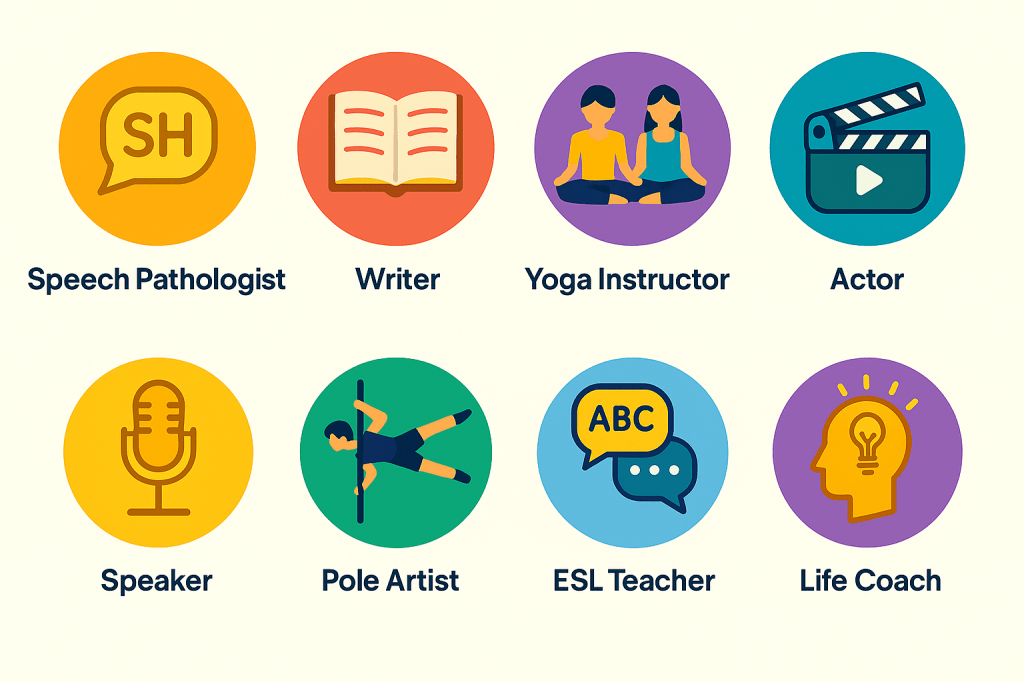
I’ve never been someone who fits neatly into one box. I’m a speech pathologist, a writer, a life coach, an actor, a yoga teacher, an ESL educator, a business owner, and yes, someone who hangs upside down on a pole for fun.

And somehow… it all makes perfect sense to me.

Being a polymath feels like living in colour. Every skill I learn feeds another part of my life. Every curiosity becomes a doorway. Every new passion adds a layer to who I am and how I show up in the world.

Speech Pathology taught me to communicate with purpose

Working with kids and families has given me the deepest understanding of communication, not just the mechanics, but the heart behind it. Helping someone speak, read, learn, or connect unlocks something inside me too.

Life coaching taught me to listen, REALLY listen

Coaching helped me tune in to people’s dreams, fears, habits, and patterns. It made me a better therapist, a better friend, and honestly, a better human. It’s one of the skills that anchors everything else I do.

Acting taught me to feel everything fully

Acting is where I get to be bold, expressive, vulnerable, and creative in ways everyday life doesn’t always allow. It’s helped me understand characters, emotions, humanity – which loops right back into my coaching and therapy work.

Writing taught me to make sense of the world

Words are how I process life. From “The Speakable Child” to the new projects I’m creating, writing lets me turn ideas into stories, and stories into something useful for someone else.

Yoga taught me to breathe and soften

Yoga balances the fire. It reminds me to slow down, feel my body, and come back to myself, something all polymaths need because our brains can be like hummingbirds.

Pole art taught me strength, discipline, and play

Pole is where I surprise myself the most. The strength, the flow, the artistry; it’s a celebration of being human. It’s creative and athletic at the same time, and it’s one of the places where I feel the most free.

Business taught me courage

Speakable didn’t build itself. It took years of ideas, risks, failures, and growth. Being an entrepreneur showed me that creativity isn’t just an art; it’s a strategy.

What I love most about being a polymath

It’s not the titles or the skills.

It’s the way everything overlaps.

My acting improves my communication coaching.

My coaching improves my therapy.

My therapy work gives depth to my writing.

My writing clears my mind for yoga.

Yoga strengthens my discipline for pole.

Pole energises me for everything else.

It’s all connected like a tapestry of passions that weave together into one life.

I love being a polymath because it lets me be all of me.

Not half. Not one slice.

All.

And if there’s one message I hope people take from my journey, it’s this:

You don’t need to choose one dream.

You’re allowed to choose many and let them shape you into something extraordinary.

Binh

From Idea to Impact: 11 Lessons in 11 Years of Speakable

This year, we celebrate 11 years of Speakable Speech Pathology – a milestone that reminds us how far a simple idea can grow when it’s backed by passion, persistence, and purpose. 

When I first started Speakable in 2014, I couldn’t have imagined the incredible journey it would become. What began as a vision to help children find their voice has grown into a thriving practice that impacts families every day.

Along the way, we’ve learned a lot about what it takes to build not just a business, but a mission-driven start-up that lasts. 

To celebrate, I’d like to share 11 lessons from 11 years that shaped Speakable and can help guide anyone dreaming of starting something of their own.

1. Start with purpose

The heart of any successful start-up is a clear “why.” For Speakable, it was simple: helping children become confident communicators and learners. Purpose fuels resilience – it’s what keeps you going when things get hard.

2. Solve a real problem

A start-up only works if it addresses a genuine need. Parents were searching for practical, evidence-based strategies to support their children’s speech and language. Speakable was built to fill that gap with accessible, personalised solutions.

3. Begin small, dream big

Speakable didn’t begin with a full team, branded office, or polished systems. It started with a commitment to serve (and a small table). Growth followed naturally as we stayed focused on helping one family at a time.

4. Build relationships, not just clients

Our growth has always come from word-of-mouth referrals and long-term relationships. People don’t just buy services as they invest in trust, care, and genuine connection.

5. Adapt and evolve

The pandemic taught us this lesson most vividly. We pivoted to online services, developed new resources, and found ways to support families remotely. Flexibility kept us relevant and resilient.

6. Hire for heart and skill

As Speakable grew, so did our team. We learned to bring in people who not only had the expertise, but also shared the same vision and values. Culture is the backbone of a strong start-up.

7. Keep learning

Running a business means wearing many hats. At the start, I was a clinician, a marketer, a manager, a technician, a cleaner and a coach. I invested in learning constantly, whether it was professional development, business strategy, or leadership training.

8. Celebrate small wins

Every milestone matters. From a child saying their first word to expanding our clinic, celebrating progress kept the journey joyful.

9. Stay financially grounded

Growth is exciting, but sustainability requires careful planning. From reinvesting profits to setting fair fees, keeping Speakable financially healthy ensured we could keep serving families long-term.

10. Give back

Success isn’t just measured in profit – it’s about impact. Speakable has always been about more than therapy sessions. It’s about empowering parents, training future clinicians, and sharing knowledge through workshops and writing.

Over the years, we’ve also extended our impact by supporting charities such as the World Food Programme, Blue Dragon Children’s Foundation, and One Tree Planted. Giving back has been an essential part of our journey because true success comes from creating ripples of change beyond your own business.

11. Never lose sight of the vision

Through every challenge, from long hours to unexpected changes, the vision of Speakable – to give children a voice – has been the guiding light. That vision has kept us grounded, inspired, and moving forward.

Looking ahead

Eleven years in, Speakable is stronger than ever. The road hasn’t always been easy, but it has been worth it. If there’s one message I’d share with anyone starting a new venture, it’s this: anchor yourself in purpose, stay adaptable, and keep learning.

Here’s to the next chapter, and to every dreamer ready to turn their idea into something remarkable.

Big hugs, 

Bình 

Blending Art and Science: The Intersection of Acting and Speech Pathology

As someone deeply embedded in both the acting world and the realm of speech pathology, I’ve discovered some powerful synergies between the two disciplines that have profoundly influenced my approach to therapy.

Acting, at its core, is about communication—conveying emotions, ideas, and narratives in a way that resonates with an audience. Similarly, speech pathology focuses on enhancing a person’s ability to communicate effectively. 

But how exactly does acting influence my practice as a speech pathologist? Let me share some real-world insights and stories from my journey.

Using acting techniques to build confidence

One of the first lessons in acting is about building confidence—being able to stand in front of an audience and deliver your lines without letting your nerves get the better of you. This aspect of acting has been invaluable in my speech pathology sessions, especially with clients who struggle with speech anxieties or social communication.

For instance, I worked with a young client, let’s call her A, who was extremely shy and had difficulty speaking up in class. Drawing from acting, I introduced her to warm-up exercises like those used in theatre rehearsals. We practiced projecting her voice, using exaggerated expressions, and even some improvisation games. Over time, Mia’s confidence increased. She began participating more actively in class discussions and even joined drama as one for one of her school subjects.

Emotional expression and speech dynamics

Acting has taught me a lot about the nuances of emotional expression and how these can enhance speech dynamics. In therapy, I often use exercises that actors employ to convey different emotions through tone, volume, and pace. This is particularly useful for clients who speak in a monotone or whose speech lacks variation.

Take the case of S, a teenager with autism who struggled with monotonous speech. By incorporating role-playing scenarios that required expressing excitement, sadness, or curiosity, S began to understand how his tone could change the meaning of his words. His newfound ability to vary his speech made his communication more engaging and expressive.

Script analysis and speech planning

In acting, script analysis helps actors understand their characters’ motivations, which influences how they deliver their lines. This concept translates seamlessly into speech pathology, where I teach clients to plan their speech depending on their communication goals.

For example, during a session with a client preparing for a job interview, we analysed typical interview questions as if they were lines from a script. We discussed the intent behind each question and planned appropriate responses, focusing on delivering them in a way that showcased his strengths and enthusiasm for the position.

Feedback and adjustment

Finally, the iterative process of acting—where you continually receive feedback and make adjustments—is a critical component of effective speech therapy. Just as a director provides feedback to actors, I provide continuous, constructive feedback to my clients to help them refine their communication skills.

In a recent group therapy session, we created a mini-play, and each participant had roles with specific speaking parts. After each run-through, we discussed what went well and what could be improved, much like a rehearsal discussion in a theatre setting. This not only helped in fine-tuning speech skills but also fostered a supportive community among the participants.

Conclusion

The intersection of acting and speech pathology is a testament to how art and science can blend beautifully to enhance human capabilities. By integrating acting techniques into my speech pathology practice, I’ve been able to offer unique, creative solutions that motivate, inspire, and make learning enjoyable for my clients. Whether it’s through confidence-building, emotional expression, strategic planning, or iterative feedback, the art of acting continues to enrich the science of speech therapy in dynamic ways.

This cross-disciplinary approach not only makes therapy sessions more effective but also more enjoyable, proving that sometimes, a touch of art is just what science needs to change lives for the better.

I’d love to hear your thoughts or experiences on blending art with science in your own careers. Drop a comment below or reach out on my socials!

Bình

“An Inspector Calls” at Darlo Drama, Sydney, 2023

“Macbeth” with Matt Dell at Darlo Drama, Sydney, 2024
Advertising for Pearson, Sydney, 2024

Whatever it takes!

After graduating from speech pathology, I was jobless for 6 months.

I worked as a waiter to pay for food and transportation. I slept on my friend’s couch.

Spent most of my savings on driving and flying to interviews in another state.

In the end, I got a job in Sydney at a minimum wage – as a speech pathologist.

I was super thankful. Had to start somewhere somehow.

With a few books and some clothes, I drove through the night from Brisbane to Sydney. Slept in my car for almost a week before finding a home.

You become stronger through hardship!

Chase that dream. Make it happen. Whatever it takes!

🎯 🔥

Bình